Signs that I've been in your room by Katarzyna Skiba

 
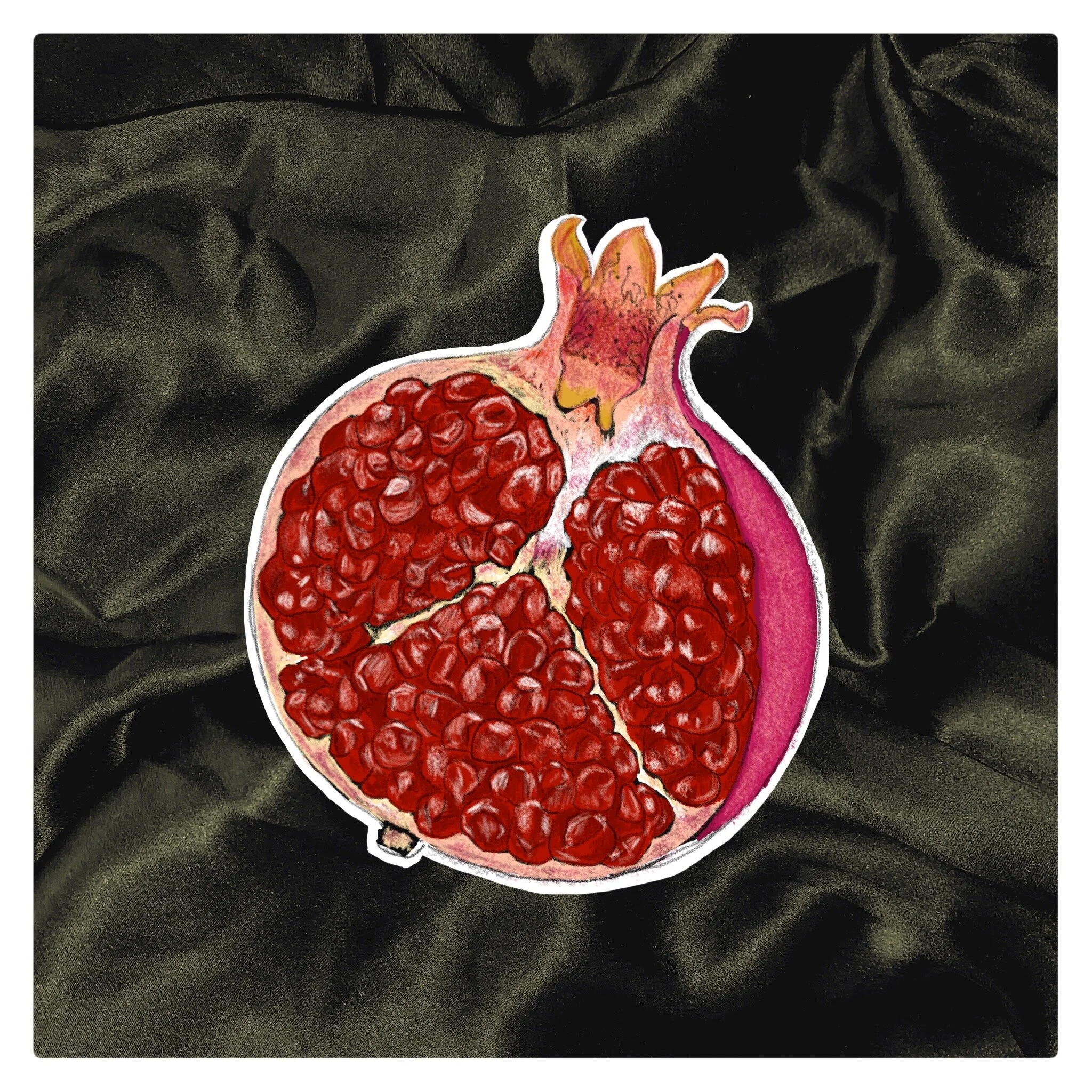
Illustration by Bella Aldrete

Illustration by Bella Aldrete


I’ve left dishes in the sink
And, not only in the sink, which is filling up,
A scavenger hunt
Because I didn’t want you to get bored once I left,
I’ve left mugs all around the room for you to find
Some half-filled with coffee which went cold too fast this morning,
Separating from still-oily cream
And others with water
And others with rings of tea
Which has been brewed several times,
Each one littered with lipstick stains
Reddish, pinkish, fading chromatography experiments
A sign that I’ve been there
That way you know which ones are mine
And better yet, I left you something to do
In case you’re bored
You can read my tea leaves,
Or interpret the coffee rings I left on the table
Decode mini Rorschach tests made of lipstick
On the edge of the cups
Or find some symbol in the bubbles of dish soap
Dissipating in a soaking pan
Or find some other excuse
To ignore the fact
That I forgot to do the dishes
And I used up too many mugs

Katarzyna (she/her) is a current junior at Columbia GS, majoring in urban studies. She’s from Chicago (a fact which she cannot stop mentioning), and she enjoys writing, cooking, and watching netflix comedy specials. Once she sent an essay of hers to someone and he called her "low-key chuck palahniuk or camus" so she guesses that's something. You can find her on Instagram, Facebook, and Twitter.

Spider Ring by Tristen Pasternak

 
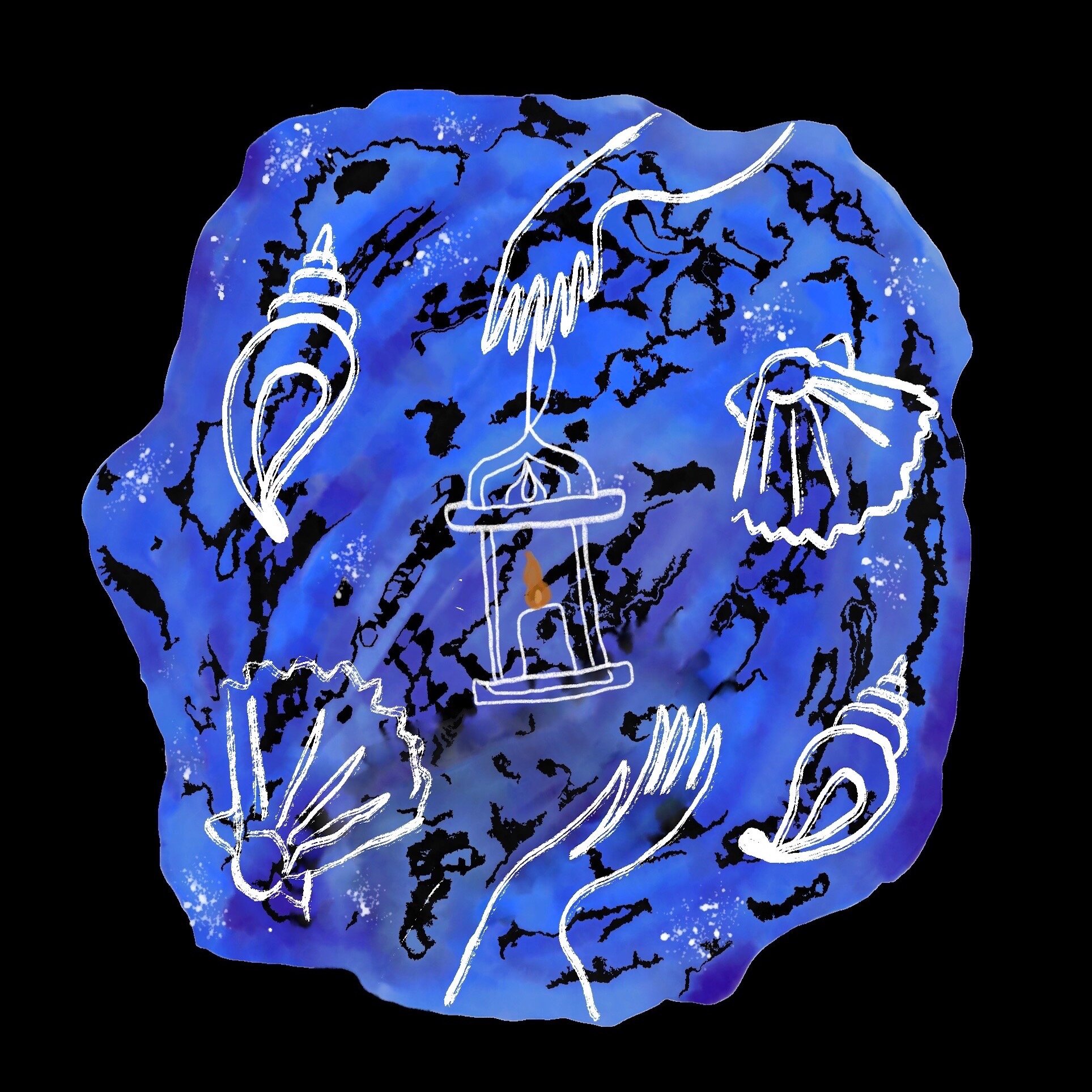
Illustration by Rawan Hayat

Illustration by Rawan Hayat


A past, a path, a past path that I had been on has now diverged into the stream of now on which
I float on my back and watch the city at my feet decimate itself. The strings that tied this web
together have grown heavy under the drops of dew and the sun is beginning to rise the clouds
are pregnant with coming light and it is time to build again. I have woven a web but I have never
caught other spiders this way life feels very partially alone. At home there was the largest spider
I had ever seen. I stared at it under vulnerable light before I set it free. There too was a firefly. It
was contained in this space and it lit and grew an orb alone. It awoke me from my sleep and I
thought I heard it calling my name. Above my bed the spiders crawled and dropped. A jolt
before I slip away: a miraculous ariel feat. A creature with one thousand legs twirls above my
head and sounds like chipping glass. Twirling slowly and dancing. On my face. Awake. And
gone.

Tristen (she/her/hers) is a member of the Barnard class of 2022 and she is majoring in English. Tristen is from the Philadelphia area. You can find her on Instagram and Facebook.

Untitled by Skylar Wu

 
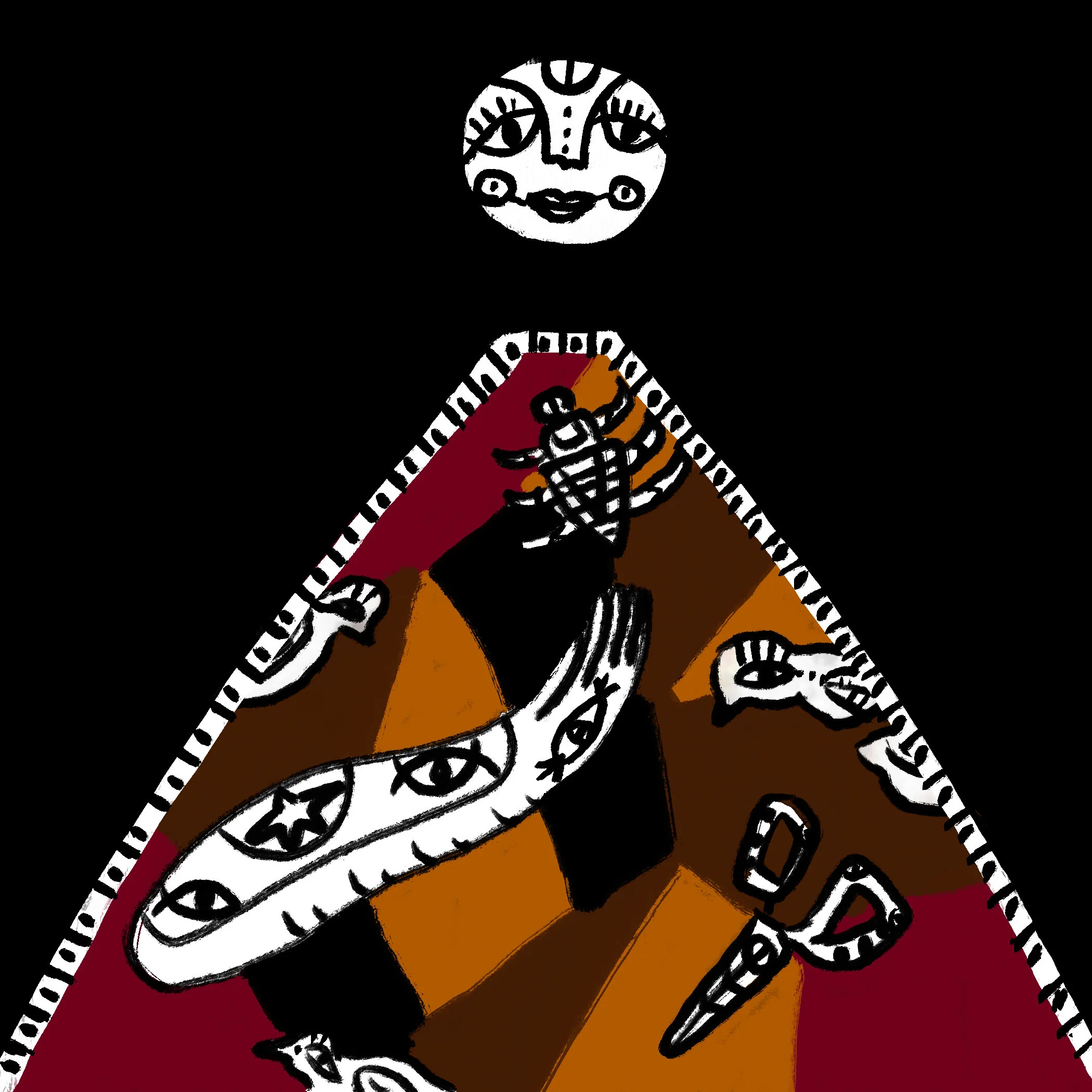
Illustration by Mitali Sharma

Illustration by Mitali Sharma


this is not smoke
not fire
it is sun, kneaded into pieces

you are not a flag
not a shadow
but i retrieve myself from your eyes

this is not any word
or any sentence
just, a scene of the moon

I imagine you looking at the moon
flying over mountains and waters
the imagination finally returns to me

Skylar (she/her/hers) is a first-year Columbia College student on track to double major in philosophy and economics. Her best habit is that she drinks at least 1 liter of water every single day and her worst habit is that she likes to bite her nails into rectangles with 90 degree internal angles. You can find her on Instagram @adnxture and @allocated.resources.

Notes from an Estranged Daughter by Crystal Foretia

Quarto 2020 Chapbook Contest Runner Up

Click on the image to read a PDF version of Crystal’s chapbook.

Illustration by Zain Murdock

Illustration by Zain Murdock

My name is Crystal Foretia (she, her, hers), a sophomore in Columbia College studying Political Science and History. Born and raised just outside of DC, I am the daughter of Cameroonian immigrants. Notes of an Estranged Daughter is a collage of anecdotes and contemplations on Black history. Some poems are inspired by and directly respond to art either by Black people or centering Black figures. Other poems draw on confrontations with internalized, interpersonal, and structural racism. Overall, the piece explores the feelings of a young Black woman trying to make sense of a world made chaotic by colonialism and white supremacy.

“Madeleine, la femme noire” was published in The Unorthodocs: https://www.theunorthodocs.org/la-femme-noire. “Under the Weeping Willow” was published in Surgam, the literary magazine for The Philolexian Society: https://surgammag.files.wordpress.com/2020/07/surgam_spring20_20_final.pdf. Lastly, “what the conch said to the black child” was already published by Quarto Online on Oct. 27th.

New and Used Poems by Thomas Mar Wee

Quarto 2020 Chapbook Contest Runner Up

Click on the image below to read a PDF version of Thomas’s chapbook.

Illustration by Dora O’Neill

Illustration by Dora O’Neill

Thomas Wee is a writer based in New York and a senior studying English and Comparative Literature at Columbia University. Born and raised in Evanston Illinois, they began writing short fiction and poetry in high school. Academically, their interests include: Modernism, semiotics, translation, Asian American literature, and digital humanities.

A writer of poetry, fiction, and mixed media work, they are currently working on a short story collection and a novel. A piece of their short fiction will be featured in the upcoming Meridian Anthology of New Writing published by Drunken Boat and Asia Pacific Writers & Translators (November 2020).

The chapbook "New and Used Poems" represents poems accumulated over several years of writing, the earliest written in Summer 2018 and the most recent written in Fall of 2020. Together, they cohere loosely around themes of grief, inheritance, cultural assimilation/decay, liminality, and memory. These poems are primarily inspired by the poet's early loss of their father, and their experiences as a mixed-race, Chinese-American, queer person.

Formally, these poems explore the relationship between language and memory, and specifically the way memory and language degrade and fail. The opening introductory triad of poems, grouped under the title "Generation Loss", deals with this theme the most explicitly through its method of composition via online translation algorithms.

The three photographs, meant to accompany this poem and the chapbook as a whole, are an image of the poet's grandfather and extended family, taken in their village in Taishan, China. This photograph was compressed and duplicated several times, with each copy degrading its quality slightly and introducing artifacts, noise, and other elements of deterioration. These photographs are meant to reinforce the chapbook's themes, and prompt thinking about the relationships between different forms of decay: cultural, material, mnemonic and digital.

what the conch said to the black child by Crystal Foretia

 
Illustration by Zain Murdock

Illustration by Zain Murdock


we're quite different, 
you and I.

sure, you rugged on the outside 
and smooth on the inside,

maybe we can even pull
a pearl outta you too.

but you not hollow on the inside,
not whitewashed on the outside.

erosion is not your destiny,
no matter the lies society tells.

your bones don’t belong to the sea,
no matter what history yells.

unlike me,
you always existed

to be more than the market’s currency,
to be more than an exotic accessory,
to be more than a herald of tragedy.

before they plunder your pearl,
harvest your flesh from inside out, 
and play you to the beat of their symphony,

Remember: 

you are no husk left behind.

Crystal (she/her/hers) is a sophomore at Columbia University studying Political Science and History. As the daughter of Cameroonian immigrants in the suburbs of Washington, D.C., her political awakening has been one of contradiction and frustration. Being a first-generation African-American places her in a unique relationship with Blackness and forces her to center her poetry on history, both personal and political. You can find her on Facebook and Instagram.

Sex Without Fear by Tristen Pasternak

 
Illustration by Rawan Hayat

Illustration by Rawan Hayat


Craving sex like the devil but I fear it
More than God
God was so fearing
Of sex
I heard he made people out of stars
Must’ve been hot

He ripped a rib
Out of his first and only human
Just to make a point
I don't know about you but I have a few ideas
About a better way
to make a baby

That gift of God-giving life was more divine
When God found a way around it
Divine virgin let me know
God, let me know
How to have sex without fear

Tristen Pasternak (she/her/hers) is a member of Barnard class of 2022 studying English and creative writing with a minor in Spanish. Tristen is from the Philadelphia area and her favorite color is orange. She enjoys walks in Riverside Park and would like to own as many orange things as possible. Find her on Facebook and Instagram.

Mga Katutubong by Alyssa Sales

 
Illustration by Charlie Blodnieks

Illustration by Charlie Blodnieks


the churches drown them.

gold crosses hang from brown necks 
one Lord’s history and one God’s 
biased truths fill crusted 
mahogany colored books

their hearts shatter— 
do their people not remember? 

has their country forgotten 
their ancestors’ battle cries 
as men with pale skin and sharp teeth
rode on four-legged beasts? 

their memories of beautiful 
traditions and infinite gods erased

their country has forgotten  
the men cloaked in coal black robes who
dragged wailing children to angelic churches
and shoved the sweet body of Christ 
on pink tongues that begged for mercy

but they remember. 
they sit in the mountains, 
waiting as the goddess Tala’s 
eyes flutter open and 
her freckles appear 
as burning stars 
like candles on a midnight sky

they dance with the wind amidst 
emerald greens in cornfields, 
feeling Lakapati’s breath warm on their 
collarbones as they wish for good harvest 
following summer monsoons

the others don’t understand— 
their parents dressed them in lace
white dresses with curved edges,
ghosts of the Spanish’s hands imprinted
on pure pious beauty

but the indigenous 
remember even when 
everyone else doesn’t.

they lie on wooden rafts as the sea hums 
a soft lullaby, fingertips sliding 
along Aman Sinaya’s cerulean blue waves

they look out to 
gods and goddesses 
who gave them strength 
as they whisper prayers

naaalala namin. 
we remember.

Alyssa Sales is a Sophomore in Columbia College who lives in Palo Alto, CA but misses the busy New York City scenery. She is planning on double majoring in Neuroscience and Behavior as well as Creative Writing. Writing is a way for her to process her thoughts, reflect on herself, and memorialize the world around her.

Home Now by Sam Losee

This piece was first published in Quarto’s 2020 Spring Print Edition.

 
Illustration by Gisela Levy

Illustration by Gisela Levy


Instead, I’ll say maybe it’s enough: the watercolor Kermit on the wall, shot glasses filled with
gomphrena and statice, orchid and oatmeal box on the top shelf, the soft scratch of thumbing
through black dawn pages. Even the blankets and moisturizer mean something different now. I
forget to take out the compost most of the time, but nobody minds. I leave the teabag in so long it
dries up completely, stare blankly at New Jersey and the dog walkers until the orange dusk joins
me on the window seat, tripping over the sill with attempted grace. I can’t remember the last
time I tied my red shoelaces. I get by washing my bangs in the sink and playing songs with good
basslines so loud I have to skip class. Sometimes, I wonder if the mice are happy, or what’s the
best thing they’ve ever discovered. Cue fairytale doom. I’m afraid of the same things they are,
except cigarettes. I think about how I’d be a terrible knight. Someone smudges “i love u” onto
the other window, and I spend too much money on food. When I’m lucky, the bodega cat sits on
my feet. I don’t know how to say his name, his cheek an egg in my palm, so I call him “First
Night,” and he doesn’t mind that I have so little vocabulary to choose from. He’ll never know
body high, slapping hands on doubled playing cards, river mirror, the urge to sink beneath it.

EVENINGS AT THE SHEDD AQUARIUM by David Ehmcke

This piece was first published in Quarto’s 2020 Spring Print Edition. 2020 poetry winner, selected by Safia Ehillo.

 
Illustration by Mitali Khanna Sharma

Illustration by Mitali Khanna Sharma


The beauty of it, I think, is in its formlessness—
how the flesh of the anglerfish wavers, not unwavelike,
as it traverses the waters of the deep benthic zone,

unharnessed from the greater laws
that govern the more worldly forms
that light, less effortfully, the brighter waters above—

This world is called DEEP OCEAN DWELLERS
and is much darker than CARIBBEAN REEF,
where, at these less sunny hours,

the sea turtles sleep on a small stretch
of synthetic sandy beach. As for my angler,
all that keeps me from it

is one inch of sturdy glass.
In dreams, I’d find a wetsuit or mallet
and know that I could touch it,

could close my fist around its illicium and pull—
But the anglerfish, exile
of the ocean, knows no violence

like this, not the brilliant shock of a human hand.
All it knows is the light that hangs
unfailingly before its eyes, and the glass that keeps me

from it. For its many years it will follow its esca,
dutiful lamp-light it has carried since birth. No,
the beauty of it, I think, is in its piety—

The anglerfish swims believing
that as long as this light stays lit, no hunger will ever be
endless. If the anglerfish had words,

would it deny me this? Would it sing?
If it were me, would it not extend an arm
and take its esca in its fist,

cradling that ordinary light, like a minor God,
in its ordinary palm, saying beauty, beauty...
In dark uneven waters, is there no reason to know me?

David Ehmcke is a recent graduate of Columbia College. His work has appeared or is forthcoming in Cosmonauts Avenue, Deluge, The Columbia Review, and elsewhere. In spring 2020, he received Quarto's Poetry Prize; the Brick Prize for his play FEED; and received the John Vincent Hickey Prize for an essay that studies Ariana Reines’s A Sand Book, new media, and the occult. A current Henry Evans Fellow, David will travel to London in 2021 to begin a book project in the British Museum that investigates curation, museology, and the poetics of the museum.

I lose my virginity in a Young Adult novel by Sam Losee

This piece was first published in Quarto’s 2020 Spring Print Edition.

 
Illustration by Gisela Levy

Illustration by Gisela Levy


I have nothing to say to him. This is a boy and his hair is
quicksand. I shed the prom dress like a last glass cocoon
and I sweat pure glitter but he can’t even see it.
No one here still wears corduroy or dreams about their teeth
falling out. So far, the only side effects have been extra
bike bells, chickadees, and the girl next door taking diligent notes.
She highlights my collarbones, shy moon on our shoulders,
And the boy tastes like warm, that’s all. He smells like 11 pm,
Shitty car, the most mundane apocalypse this street has ever seen.
Losing my virginity is bigger than God’s mouth. Not a secret:
I don’t actually have genitals. He asks if it’s really my first time.
I’m so good at this. I answer, virginity is something you scoop
with a fishing net, something you catch and eat for dinner later,
picking flesh apart with claw and metal until you’re full again.

Budapest-Nyugati pu to Praha hl.n. by Sarah Barlow Ochshorn

This piece was first published in Quarto’s 2020 Spring Print Edition.

 
Illustration by Mitali Khanna Sharma

Illustration by Mitali Khanna Sharma


Fond of laughing and
no longer in Budapest
I sleep warmly alone, watch
tin roofs and muted houses run
backwards out the window

Sleeping on trains instead
of in bed with you, Slovakia
muffled against my ears,
the drone of the wheels that
pull me into a stupor

You would like the mint green
laced across Czech towns you
would whisper it in my ear color
tipping as we slip
sideways, reaching the border

Back in New York you
call me from gold-lipped
concrete, walk me past the bookshop
on Fifth Street, hold me
in your pocket beneath blossoms
of a spring I am missing

You, gold-lipped under cool
sheets. You, blossoming
like the sweet June air. You,
crooning in my head as
the train reaches the station.

Sarah (she/hers) is a poet from Brooklyn, NY. She's a senior at Barnard, majoring in English with a concentration in Creative Writing and a minor in Women’s, Gender, and Sexuality Studies. Writing poetry has always been a part of her life, and she's loved getting to nurture and expand her craft while at Barnard. When Sarah is not writing, she loves to dance, play bananagrams with friends and family, and brush up on her embroidery skills.

LATER, REMAKING THE BED by Siri Gannholm

This piece was first published in Quarto’s 2020 Spring Print Edition.

I did not want not to be quiet
but last night you folded me in place

of our clothes which clung to the floor
in shreds shed petals dewy

by the time we awoke I opened
my mouth in place of my eyes

your body’s length gathered
in my arms in pleats cries of quails

fluttered down on us rustling
and it wasn’t till I placed

my mouth on your shoulder
that I caught the deer’s

eye as it moved
through grass gaze resting

for a moment on our sheets
unblinking

how far did it come
did it walk to bear witness

Illustration by Gisela Levy

Illustration by Gisela Levy

night fruit by Anna Desan

This piece was first published in Quarto’s 2020 Spring Print Edition.

 
Illustration by Gisela Levy

Illustration by Gisela Levy


In Audubon Eastern Landbirds 1946,
there is a photograph of a bird I ran over
in an empty parking lot.

From God’s mouth
drops the commandment
grow from nothing.
From His hands
drops the apple,
which tastes different at night
when knowledge is unwanted.

His attention to detail
is shown in the nervous system of a bird
splayed out something like a garden.
Sorrow,
bright as silver dollar,
blossoms under the skin.

No one mentions the obvious:
that of course bodies will be
left,
that I will one day marvel at
how slow this leaving can be.

The heavy sunlight writhing
in idle cars—
the light which doesn’t announce itself
as light—
tastes different
over carnage.

4 the west side by Hanna Dobroszycki

This piece was first published in Quarto’s 2020 Spring Print Edition.

I’m a slut
for Architectural Digest

the leather plush black couch

& rug
—featured on Page 1

within the foyer
says

i have a rug made
of lamb

choking the
mahogany floor

is my
middle name, you may call me

from now on
in my glass

class bathtub
& I

music, blushed by
the window

with
the park dark view &

I filet mignon
at night,

with my husband,
kids &

I money
down the

sin skinned lobby,
saying hello
to the doorman.

Illustration by Gisela Levy

Illustration by Gisela Levy

Hanna is a rising sophomore at Barnard College, intending to pursue English with a Creative Writing concentration. She likes a big open road.

JUNK by Lorenzo Barajas

i go dumpster

diving in the

mouth of a volcano

and come up

with molten shreds

dark and glittering

shadow-mad

i lug everything

through the underground

catacombs when i arrive

submerged into

the house it’s dim i lay

everything out to cool

under the branches of

an ancestral pine

all the junk

a cicada shell

with no tenant

an heirloom hacksaw

rusted

shattered clay birds

serrated incisors

dated news from a foreign country

in the corpse-cold

moonlight it gleams and

i hold all my junk before

me in my arms.

Illustration by Mitali Khanna Sharma

Illustration by Mitali Khanna Sharma

Lorenzo Barajas is a clout-chasing Californian pursuing a degree in English (and possibly Art History) to unknown ends. He is interested in experimental medieval texts, early abstract expressionism, and intersections with his identity as a trans Mexican-American.

Diagnostic Criteria by Sarah Barlow-Ochshorn

This piece was originally published in Quarto’s 2020 Spring Print Edition.

 
Illustration by Mitali Khanna Sharma

Illustration by Mitali Khanna Sharma


Trigger Warning: mental illness, depression

Diagnostic Criteria

   A. Wherever there is soil, plants grow and produce their kind
        a. All plants are interesting
   B. When a person makes a choice as to what plants he shall grow in any given place, he becomes a farmer
        a. If the conditions are such that he cannot make a choice, he may adopt the plants that grow there by nature
        b. By making the most of them he may still be a gardener or a farmer in some degree
   C. If there is not a foot of land, there are porches or windows
        Note: Every family, therefore, may have a garden

Diagnostic Features

The criterion symptoms for major depressive disorder must be present nearly every day. Must be present as you let the soil from your window boxes sit under your nails, present as you let the small shovel fall and your fingers graze the window sill, must be as the cars on Ocean Avenue pass by without seeing into the small apartment.

The diagnosis depends on the 2-year duration, which distinguishes it from episodes of depression that do not last 2 years. 2 years after the first hospital visit, when you graft fragments: back, hips, arm to hold, mind to body. 2 years after pulling together, 2 years after and after and after when you are back in the garden.

Factors predictive of poorer long-term outcome include higher levels of neuroticism (perhaps triggered when your son breaks down his sister's bike and paints it yellow, then is unable to put it back together again. Perhaps increased when your husband dies.), greater symptom severity, poorer global functioning (Hayden and Klein 2001; Rhebergen et al. 2009; Wells et al. 1992), and presence of anxiety disorders or conduct disorder (Ochshorn, 2002).1

1 Some language from L.H. Bailey's Manual of gardening: A practical guide to the making of home grounds and the growing of flowers, fruits, and vegetables for home use and Diagnostic and Statistical Manual of Mental Disorders, Fifth Edition.

Sarah (she/hers) is a poet from Brooklyn, NY. She's a senior at Barnard, majoring in English with a concentration in Creative Writing and a minor in Women’s, Gender, and Sexuality Studies. Writing poetry has always been a part of her life, and she's loved getting to nurture and expand her craft while at Barnard. When Sarah is not writing, she loves to dance, play bananagrams with friends and family, and brush up on her embroidery skills.

When The Tour Guide Dropped Dead by Anna Sugrue

 
Illustration by Gisela Levy

Illustration by Gisela Levy


after “Grand Narrative with Chandelier” by Matthea Harvey

He woke up to find his hats
were suspended in midair, hovering

in color order, full-price
above Fifth Avenue. It meant

he couldn’t count on us anymore.
It meant our little cameras could revolt,

flip front-ways & catch him red-faced
and askew. He looked down

and his shirt was outside-in.
His white shoes weren’t there.

We were shining them with black
polish and a brush made of rat hair.

We cheered when the superhero
tore his cape in the subway grate,

the cargo ships started to row backward
when we could distinguish his card cut-out

from the crowd & when the bus crashed
through the median he gasped with us,

smirks and sunglasses, thumbs on buttons,
raining down through hat-clouds & smog.

Anna Sugrue is a senior at Barnard College majoring in urban studies and sociology. She loves to write about cities.