
The evening the lambs were born, I knew I was becoming something else. The last shafts of light had sieved through the barn’s slats, casting a lattice across the walls. From time to time, I could see the faces of my brothers against the hearth, flickering like images of saints. The straw poked through my pinafore, their trousers, but we knelt, our cheeks pulp on the railing. Between the rods, we could see the wet, shifting mass of the ewe, firm as if pear flesh. Father had already flattened a sheet beneath her, the plastic taut under its writhing. Almost there, almost there, he says, though to whom, us or the mother, we do not know. She crouches, and with a final thrust, it slithers out, this offering, into our waiting. It doesn’t cry like the babies I know, yet takes in air. I study its whiteness, slick as if basted in milk, and think about what it means to be wanted so soon, at ingress. The ewe noses her child, and I pause for the moment she will know it is hers. Father steps between us, opening the legs. This is good. More is good. I look up and notice the rough beams overhead, bleached and arching like ribs. In time, I wonder if they might give out, dip down beside us, and let God in. I did not sleep that night. I have never been more still.
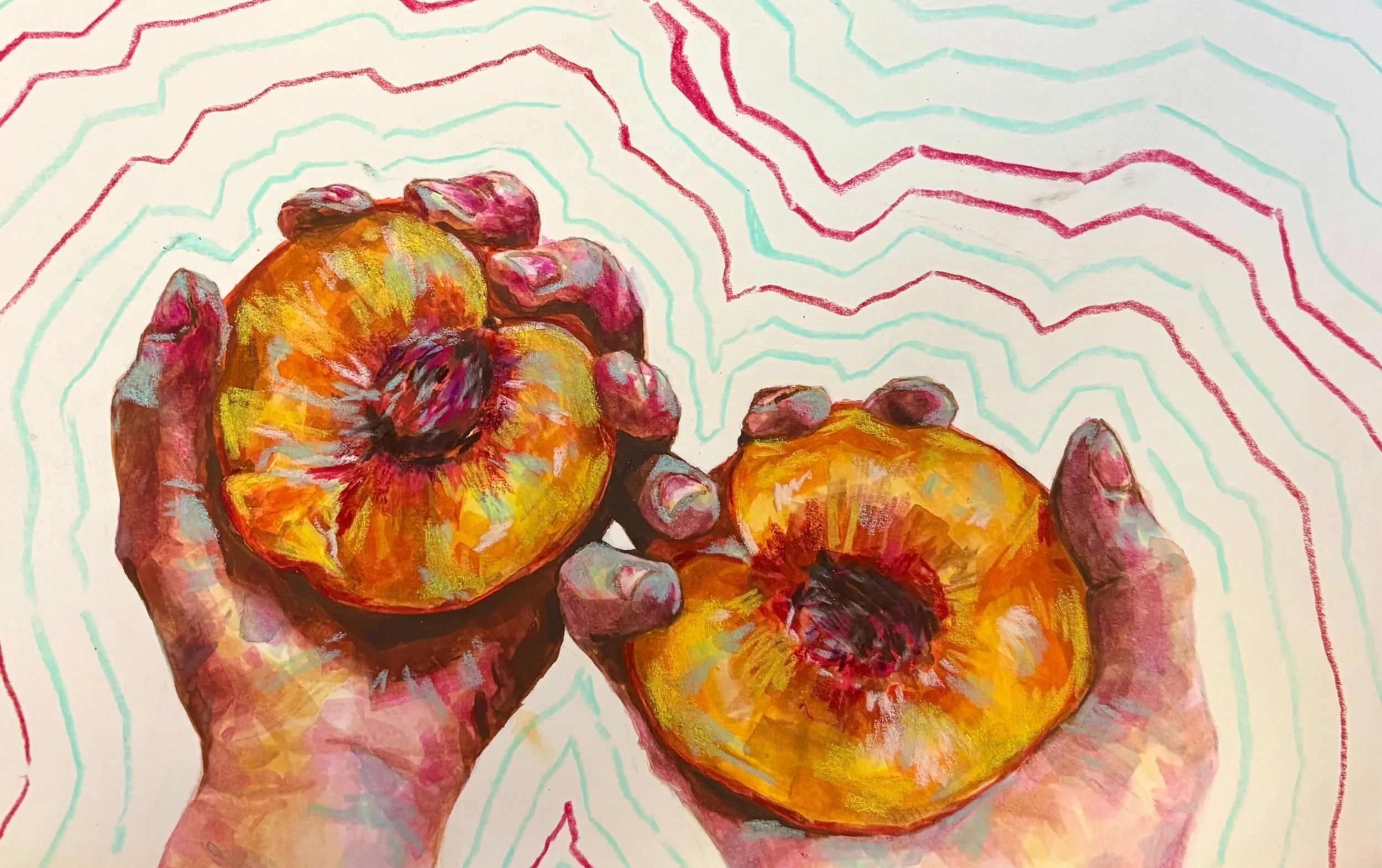
These days, our back porch is amassed with peaches bought in town. Mother doles them out evenly, spreading them across the linoleum before we peel. They’re spongy, bloated from hot water, and once skinned, she beckons me inside. She moves between the stove and table, pointing at jars, tubes of oil and vinegar. I watch as she approaches a chicken on the countertop, newly culled, and smooths the feathers. She prods it, snaps a wing, then fists herbs into the cavity. The bird lies there, headless, and I listen for her signal. She nods, and I pluck a cube of brown sugar from her pocket. I bring it to my mouth, my treat, and let the grains thaw on my tongue. I survey the chicken, now goose-pimpled and gutted. Only I have behaved.
That night, I did not think of birds and their entrails. Instead, my brothers came to mind. I could hear them playing outside, from the garden, and peeled back the curtain. Beside the barn, they moved, fevered, tossing a lamb between them. If stillborn, Father buries the carcass out back beside the acerola berries. He always lets the boys fool around with them first.
I return to bed and picture myself as a seed, swelling under earth and covers. I lift my nightgown, then stuff my duvet inside. As I placed my hand over the cotton mound, I remembered when my brothers would still sleep with me, in this room, before it became mine alone. We’d sometimes nudge our sock-feet up each other’s pyjama legs or shape ghosts from linen. They’re a quiet reckoning, these thoughts. The boys aren’t here now, but they were.
Sherine Wright (she/her) is an emerging writer born in London, England. She is studying English and Creative Writing at Columbia University, graduating in 2029, and claims a kinship with Hamlet's Ophelia. She can be found on Instagram @sherine_amber.
